

Cart
0


Unhybridised Emmer Wheat
Stone Ground, Low Heat
Lab Tested, Every Batch
Zero Additives
Dispatched in 24 Hours
Farmer-Direct Sourcing
🌿 Pure Nutrition, Simple Choices
Two wholesome products, countless health benefits.

Annrashtra Khapli Wheat Flour 4kg Box
Rs. 999Rs. 699
Annrashtra Khapli Wheat Flour is made from an ancient, un...
View Now
Annrashtra Khapli Wheat Daliya — Pack of 2 (2 × 400g)
Rs. 240Rs. 120
Annrashtra Khapli Wheat Daliya - now as a value Pack of 2...
View Now
Annrashtra Khapli Wheat Flour is made from an ancient, un...
View Now
Annrashtra Khapli Wheat Flour 4kg Box
Rs. 999Rs. 699
Annrashtra Khapli Wheat Flour is made from an ancient, un...
View Now
Annrashtra Khapli Wheat Daliya — Pack of 2 (2 × 400g)
Rs. 240Rs. 120
Annrashtra Khapli Wheat Daliya - now as a value Pack of 2...
View NowAnnrashtra Khapli Wheat Flour is made from an ancient, un...
View Now


What We Stand For
Every product we create is guided by honesty, responsibility, and respect for ancient wisdom.
Grain Before Profit
We will never blend Khapli with cheaper wheat to reduce cost. If the grain isn't authentic Emmer, it doesn't leave our facility.
Process Over Convenience
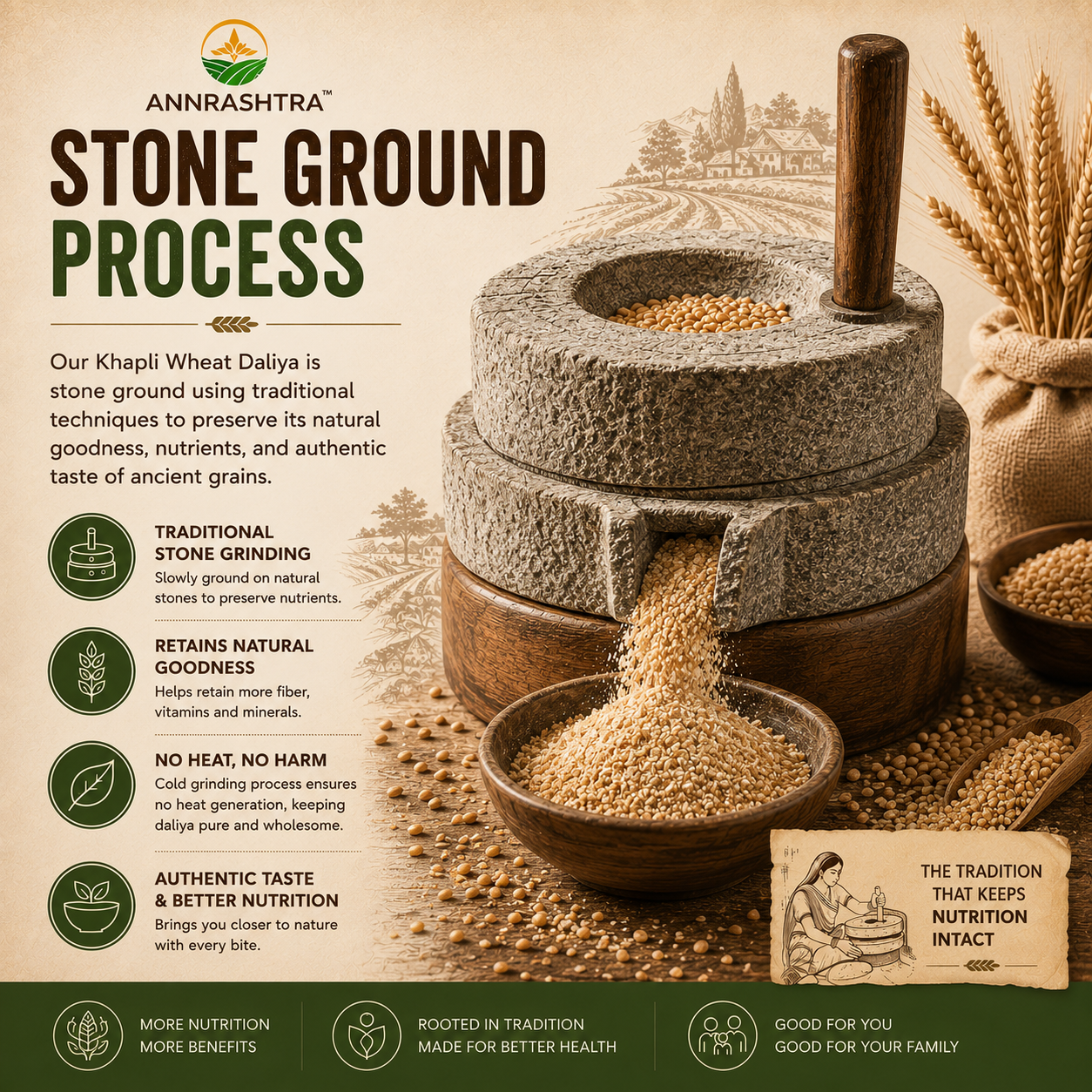
High-heat roller milling is faster. We use stone grinding at low heat instead because speed is not a good reason to destroy what's inside the grain.
Farmers First
We source directly from Khapli growers in Maharashtra. No middlemen, no opacity because the grain is only as honest as the hands that grew it.
No Claim Without Proof
We won't tell you Khapli fixes anything. We'll tell you exactly what it is, how it's grown, and how it's processed.
Batch One Standards. Always.
The quality in your tenth order will be identical to your first. Consistency isn't a promise we make at launch. It's the only standard we operate by.
Our Making Process
Pure Wheat. Honest Process.
From ancient grain to your kitchen table — every step is clean, careful, and chemical-free.
-
Step 01
Grain Sourcing
We source authentic Khapli (Emmer) wheat directly from trusted farmers in Maharashtra and MP — ancient varieties untouched by hybridisation.
Farmer-direct sourcing01 -
Step 02
Cleaning & Sorting
Each batch is hand-inspected, then cleaned to remove dust, stones, and damaged grains. No shortcuts — only the finest grain goes forward.
Zero impurities02 -
Step 03
Stone Grinding
Cleaned grain is slow-ground on traditional stone chakki at low speed. No heat, no refinement — bran, germ, and nutrients stay fully intact.
Low-heat stone milling03 -
Step 04
Quality Checking
Every batch is checked for texture, colour, and aroma before packaging. Consistent quality across every pack, every time — no exceptions.
Batch-level inspection04 -
Step 05
Hygienic Packaging
Packed fresh in a clean, controlled environment. Sealed immediately to lock in freshness — no preservatives needed when the process is right.
FSSAI certified facility05 -
Step 06
Delivered to Your Door
Orders dispatched within 24 hours. Free shipping across India above ₹999 — ancient grain nutrition, right to your kitchen.
Pan-India delivery06

Quality You Can Trust
Every batch is carefully checked and packed to ensure purity, freshness, and consistent quality in every pack.
FSSAI Certified
Produced and packed in compliance with FSSAI standards, ensuring food safety and quality.
Quality Checked
Carefully selected grains and monitored processing to maintain premium product quality.
Hygienically Packed
Packed in clean and controlled conditions to preserve freshness and natural goodness.
🌾 Annrashtra Kitchen
Healthy Recipes with
Khapli Wheat
Nourishing, easy-to-make recipes using ancient Khapli wheat flour and daliya — for your family's everyday wellness.
🥣
⭐ Featured Recipe
Khapli Wheat Daliya Porridge
A warm, creamy breakfast bowl packed with fibre, protein, and essential minerals. Made with Annrashtra's stone-ground Khapli Daliya — the ancient grain your body loves.
15
Mins
2
Servings
Easy
Level
220
Calories
🫓
Breakfast
Khapli Wheat Roti
Soft, wholesome rotis from stone-ground Khapli atta. Higher fibre, better taste, lower glycemic index than regular wheat.
🥗
Breakfast · Diabetic Friendly
Daliya Vegetable Upma
A savoury, veggie-loaded upma made with Khapli Daliya. Low glycemic, high protein — perfect for a healthy start.
🫔
Snack
Methi Khapli Thepla
Crispy, flavourful theplas made with Khapli atta and fresh methi. A guilt-free snack loved by everyone.
🥙
Lunch & Dinner
Aloo Khapli Paratha
Stuffed parathas with spiced potato filling, wrapped in nourishing Khapli atta. A wholesome lunch for the whole family.
🍮
Dessert · Diabetic Friendly
Daliya Jaggery Halwa
A traditional sweet halwa made with Khapli Daliya and jaggery — naturally sweet, nutritious, and guilt-free.
🍲
Diabetic Friendly
Daliya Moong Khichdi
A light, healing khichdi combining Khapli Daliya with moong dal. Perfect for digestion, ideal for diabetics.
🌾 Cooking Tips for Khapli Wheat
Get the best out of your Annrashtra Khapli flour & daliya with these simple tips
💧
Add Extra Water
Khapli atta absorbs more water than regular wheat. Add 10–15% more water while kneading for soft rotis.
⏳
Rest the Dough
Let the dough rest for 15–20 minutes after kneading. This makes rolling easier and rotis softer.
🔥
Medium Flame
Cook daliya on medium-low flame for even cooking. High heat can make it sticky or unevenly cooked.
🫙
Store Airtight
Keep Khapli flour in an airtight container. Stone-ground flour retains natural oils — refrigerate in summer.
Dealership Enquiry
FAQ's
Q1. How is Khapli different from regular atta?
Modern atta is typically made from dwarf wheat varieties developed in the 1960s, optimised for high yield and industrial milling. Khapli (Emmer) is a heritage grain that predates those breeding programmes by thousands of years. The two are different wheat species — different protein composition, different gluten structure, different fibre content. Beyond nutrition, they taste different: Khapli atta has a nuttier, earthier flavour that most people notice immediately in their first roti.
Q2. Can I make regular rotis with Khapli flour? Will the texture change?
Yes, you can make rotis, parathas, theplas, and anything else you make with regular atta. The dough may feel slightly different most people find it slightly denser and more textured. The roti itself is earthier and more flavourful. Some customers add a small amount of warm water and knead a little longer. Within 2–3 uses, most people find Khapli dough easier to work with than they expected.
Q3.Is Khapli wheat suitable for people with wheat sensitivity?
Khapli has a different gluten composition from modern wheat — it's lower in certain gluten proteins and higher in others. Many people who feel discomfort after eating regular wheat report feeling better with Khapli. However, Khapli is not gluten-free and is not suitable for anyone with diagnosed coeliac disease. If you have a clinical wheat sensitivity or allergy, consult your doctor before trying any wheat product.
Q4. Is it really stone ground, or is that just marketing?
It's really stone ground on traditional chakki mills, at low speed and low heat. We use this process because high-heat industrial roller milling can degrade heat-sensitive nutrients in the bran and germ. Stone grinding preserves what the grain naturally contains. You can tell the difference in the texture (slightly coarser, more wholesome) and the aroma (freshly milled grain has a distinct smell that refined flour doesn't).
Q5. How do I store Khapli atta and daliya?
Store in a cool, dry place, away from direct sunlight. After opening, transfer to an airtight container. Because we use no preservatives, Khapli atta is best consumed within 60–90 days of milling. The freshness date is printed on every pack. Unlike refined flour, which is designed to sit on shelves indefinitely, Khapli atta is a living food and living food has a natural timeline.
Q6. Is the price justified?
Khapli wheat is a heritage variety grown in limited quantities by small-scale farmers. It yields less per acre than commercial wheat, costs more to source, and takes longer to process properly on stone mills. These are real costs. What you're paying for is a grain with uncompromised nutritional integrity, sourced directly from farmers who maintain its genetic purity, and processed in a way that keeps everything the grain naturally contains. Compare that with what you're currently paying for.
Blog Posts
REAL EXPERIENCES